“Quantum” – The Most Abused Word in Wellness
Why a Holistic Practitioner Finds Quantum Mysticism Dishonest – and What Quantum Physics Actually Says
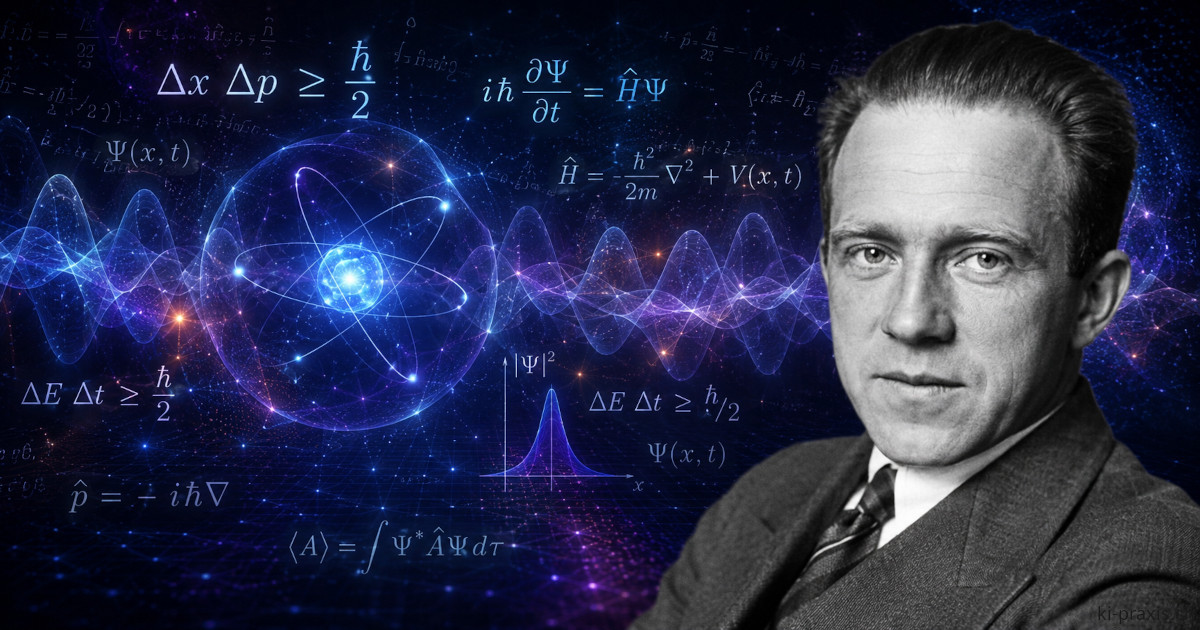
I work with energy. I practice Jin Shin Jyutsu, sound therapy, and shamanic work. I take the non-material dimensions of existence seriously – not as poetry, but as a genuine aspect of reality. So when I say that “quantum healing,” “quantum consciousness,” and “quantum energy” are largely marketing nonsense, people sometimes look surprised.
They shouldn’t be. It is precisely because I take energy work seriously that I find the lazy weaponization of quantum physics so troubling. Slapping the word “quantum” onto a product or therapy does not make it more real – it just borrows the authority of a discipline the speaker almost certainly does not understand. And it muddies the water for genuine inquiry into phenomena that mainstream science has not yet fully explained.
Physicist Dale DeBakcsy put it well in a 2014 article for the Skeptical Inquirer: the problem is “misappropriating a handful of sexy-sounding terms and then applying them metaphorically to add scientific heft to one’s particular intellectual fetish.” Physicist Murray Gell-Mann, Nobel laureate, coined a sharper term for it: quantum flapdoodle.
There are three great lies that circulate in wellness and esoteric circles under the quantum banner. It is worth examining each one – not to debunk everything non-material, but to be precise about what science actually says and what it does not.
Lie 1: “Quantum Physics Proves That Consciousness Creates Reality”
The argument goes like this: in quantum mechanics, measurement affects the measured system. The position of a particle only becomes definite at the moment it is observed. Therefore, observation creates reality. Therefore, mind creates reality. Therefore, ancient wisdom traditions that teach the power of thought have been confirmed by physics.
This chain of reasoning collapses at every link. The critical mistake is conflating a precise technical term – “measurement” – with a loose everyday concept – “observation” or “thought.” In quantum mechanics, a “measurement” is any physical interaction that extracts information from a system. It can be performed by a camera, a detector, a photon bouncing off a surface. No human mind need be involved at all.
More fundamentally, there is the problem of scale. Quantum effects manifest at the level of subatomic particles, or in atoms cooled to within fractions of a degree of absolute zero. The thermal noise in a living human body is enormous compared to the delicate quantum states that would be required for “mind-created reality” to operate. As DeBakcsy notes, quantum effects in everyday objects simply do not manifest – the numbers do not permit it.
Even where quantum measurement genuinely operates, it does not “create” reality in any meaningful sense. It selects one outcome from a range of predetermined possible states – like drawing from a hat that contains only even numbers. No matter how hard you think about it, you cannot pull out an odd one.
The phenomenon of quantum decoherence – extensively discussed in Paul Davies’ recent book Quantum 2.0: The Past, Present and Future of Quantum Physics – explains precisely why quantum superposition does not persist in warm, wet, noisy biological environments. The larger and warmer a system is, the faster it loses quantum behavior and becomes classical. Your body is very warm and very large. The quantum world and the everyday world are separated by an enormous gulf, not a subtle gradient.
Lie 2: “Quantum Entanglement Proves Telepathy and Remote Healing”
Quantum entanglement is genuinely strange, and genuinely fascinating. When two particles interact and then separate, a measurement of one particle’s state instantaneously determines the correlated state of the other, regardless of the distance between them. This has been experimentally confirmed and is not in dispute.
The leap from this to human telepathy or remote influence, however, is not a small step – it is a category error. Entanglement works because two particles, once linked, must jointly conserve a specific physical quantity – angular momentum, for instance. The “communication” between them carries no usable information; you cannot send a message via entanglement, because which outcome manifests is random. This is well established in physics.
When parapsychological writers attempt to apply entanglement to human minds, they immediately run into questions they cannot answer: What precisely is the quantum state shared between two minds? What physical quantity is being conserved? What constitutes the “measurement” that collapses the shared state? These are not rhetorical questions – they are the exact requirements that any genuine quantum mechanical system must satisfy. Without answers, “quantum entanglement” is being used as a metaphor dressed in a lab coat.
As DeBakcsy observes: entanglement “quickly devolves into nonsense when taken from its native habitat.” Strip away the strict quantum mechanical rules, and you have gutted it of its central operating principle.
This does not mean that remote connection between people is impossible, or that phenomena like distance healing have no basis. It means that quantum entanglement is not the mechanism – and invoking it does not strengthen the case. It weakens it, by substituting borrowed authority for honest investigation.
Lie 3: “Heisenberg’s Uncertainty Principle Shows That Science Cannot Know Reality”
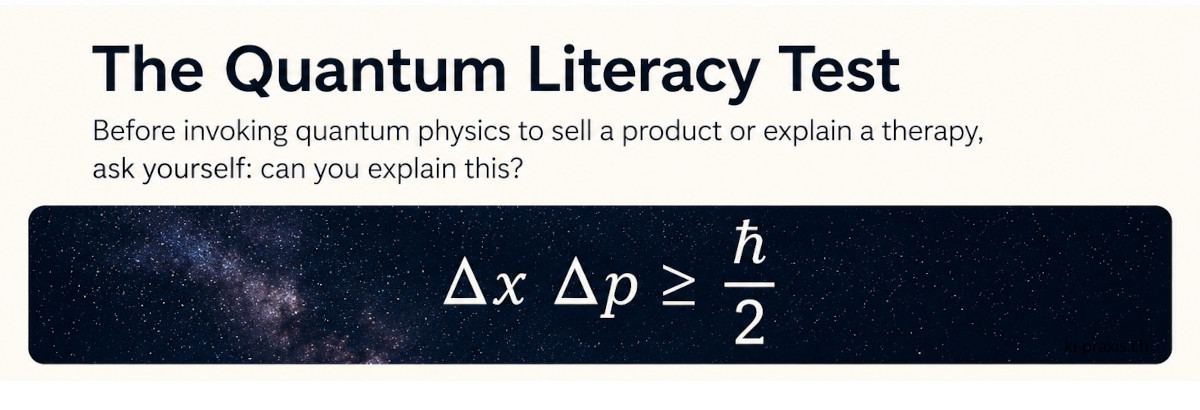
This one has a long history. When Heisenberg published his Uncertainty Principle in 1927, a generation of philosophers and mystics rushed to interpret it as proof that scientific determinism had collapsed – that uncertainty had been officially installed at the heart of nature, opening the door for alternative ways of knowing.
The Uncertainty Principle is real and important. It states that certain pairs of physical quantities – most famously position and momentum – cannot both be measured with arbitrary precision simultaneously. The more precisely you pin down where a particle is, the less precisely you can know how fast it is moving, and vice versa. This is not a limitation of our instruments; it is a fundamental feature of reality at the quantum scale.
But this is a far cry from “science has reached its limits” or “therefore spirituality fills the gap.” The Uncertainty Principle applies to specific pairs of quantities that do not commute mathematically. Many other quantities – total energy and angular momentum, for instance – commute perfectly and can be measured simultaneously with full precision. The principle tells us the upper limit of how much two quantities will interfere with each other’s measurement. Sometimes the answer is “not at all.”
Ironically, the mathematical consequences of the Uncertainty Principle have enabled deeper and more precise scientific insights than the Newtonian framework ever allowed. It is not a sign of science’s failure. It is one of its greatest achievements.
A peer-reviewed study published in Physical Review Physics Education Research in 2024 found that misreading the Uncertainty Principle as general indeterminacy affecting the macroscopic world leads students toward science denial – “the erroneous conclusion that the results obtained by quantum mechanics are false, or that science cannot provide precise answers.” This is precisely the misreading that esoteric quantum marketing exploits.
What Quantum Physics Is Actually Exploring
Here is a genuine irony: while wellness marketers freeze quantum physics at its most elementary undergraduate level – wave functions, uncertainty, the observer effect – the actual frontier of quantum research is somewhere far more interesting.
Paul Davies’ Quantum 2.0 (2024) surveys this landscape clearly. Quantum technologies – quantum computers, quantum sensors, quantum communication networks – are moving from laboratory curiosities to real-world applications. More remarkably, the emerging field of quantum biology is finding genuine quantum effects in living systems. Photosynthesis in plants appears to exploit quantum coherence to achieve near-perfect energy transfer efficiency – something a purely classical process could not manage. Birds navigate using a quantum mechanism in the cryptochrome proteins of their eyes, where entangled electron spins respond to Earth’s magnetic field. Enzyme reactions in living cells show evidence of quantum tunneling, where particles pass through energy barriers that classical physics says they cannot cross.
These are real, peer-reviewed findings, documented in journals including Nature, Science Advances, and reviewed in a 2020 paper in Science Advances titled “Quantum Biology Revisited.” They are genuinely strange. They do suggest that the boundary between quantum and classical worlds in living systems is less sharp than once assumed. They do not, however, suggest that meditation collapses wave functions, or that your “quantum field” is being disrupted by negative thoughts.
Quantum biology is a legitimate and growing field. It deals with specific, measurable quantum effects in specific biological systems. It is not a blank check for any claim that invokes the word “quantum” alongside the word “life.”
Why This Matters – Even for Non-Materialists
I want to be clear about what I am not saying. I am not saying that consciousness is reducible to neurons. I am not saying that energy work, intention, or non-material influences on wellbeing are impossible. My own practice is built on the reality of these things.
What I am saying is that quantum physics is not the explanation for them – at least not in the way it is usually invoked. And borrowing its language without understanding its content is a form of dishonesty that ultimately harms the very fields it claims to support.
When a product is marketed as “quantum healing” or a practitioner claims their method “works at the quantum level,” two things happen. First, people who know physics recognize the misuse immediately and dismiss everything associated with it – including practices that may have genuine value. Second, clients who don’t know physics are given a false sense of scientific validation for something that should stand on its own merits.
Professor Philip Moriarty of the University of Nottingham, a physicist who has written extensively on quantum mysticism, puts it precisely: the misuse of quantum terminology “undermines genuine science and misleads people into thinking mystical claims have a scientific basis” – which paradoxically damages the credibility of both science and the mystical tradition.
The phenomena that energy work, shamanism, and holistic healing address are real enough that they do not need borrowed credibility. They need honest investigation on their own terms.
Conclusion: Real Physics Is Strange Enough
Quantum mechanics, properly understood, is one of the most astonishing intellectual achievements in human history. It has transformed our understanding of matter, energy, and the structure of reality itself. It underpins the electronics in every device you own. It is genuinely, rigorously, mathematically strange – and that strangeness is earned through decades of careful experiment and exacting theory.
It does not need dressing up. And the people who dress it up – who sell “quantum water,” “quantum frequencies,” and “quantum consciousness activations” – are not bringing science and spirituality together. They are borrowing science’s authority without doing science’s work.
For those of us who work in fields that mainstream science has not yet fully mapped, the honest path is not to reach for quantum language as a shortcut to legitimacy. It is to do what quantum physicists themselves do: observe carefully, describe precisely, make testable claims where possible, and acknowledge uncertainty where it exists – which is a different thing entirely from pretending that uncertainty is the same as “anything goes.”
References and Further Reading
- Dale DeBakcsy: “Stop Heisenberg Abuse! Three Outrageous Misappropriations of Quantum Physics.” Skeptical Inquirer, May/June 2014. → Read as PDF
- Paul Davies: Quantum 2.0: The Past, Present and Future of Quantum Physics. University of Chicago Press, 2024.
- Romero et al.: “Quantum coherence in photosynthesis for efficient solar-energy conversion.” Nature Physics, 2014.
- Cao et al.: “Quantum biology revisited.” Science Advances, 2020. DOI: 10.1126/sciadv.aaz4888
- Pospiech et al.: “Analysis of pseudoscientific beliefs in quantum mechanics of high school students and teachers.” Physical Review Physics Education Research, 2024. DOI: 10.1103/PhysRevPhysEducRes.20.020145
- Philip Moriarty: “Quantum mysticism is a mistake.” IAI News, April 2023.
- Jim Al-Khalili and Johnjoe McFadden: Life on the Edge: The Coming of Age of Quantum Biology. Crown, 2014.