Iodine Deficiency – The Silent Return of a Solved Problem
A 20th-century public health triumph is being quietly undone by modern food habits – with real consequences for thyroid health, cognition, and pregnancy
A century ago, large parts of Switzerland and Central Europe had an endemic iodine problem. In some Swiss Alpine regions, up to 90 percent of schoolchildren showed signs of enlarged thyroid glands, and cretinism – severe, irreversible cognitive and physical impairment caused by iodine deficiency in the womb – was common enough that Napoleon ordered a census of cretins in the Canton Valais in 1800, recording 4’000 among 70’000 inhabitants. In 1922, Switzerland became the first country in the world to introduce iodised table salt. Within a generation, goitre had virtually disappeared, and no new endemic cretins were born after 1930.
That success is now being quietly undone – not through any failure of policy, but through a shift in consumer behavior that few people have noticed, and fewer still connect to their own health. A April 2026 column by Alice Klein in New Scientist put it well: iodised salt has become unfashionable, crowded out in kitchen cupboards by Himalayan pink rock salt, sea salt flakes, fleur de sel, and other specialty products that are widely marketed as healthier but contain no meaningful iodine. At the same time, fish consumption is declining, dairy is increasingly replaced by plant milks, and processed foods – which typically use non-iodised salt – make up an ever-larger share of what people eat.
The consequences are measurable. A 2025 study in The Journal of Nutrition, using NHANES data from 2001 to 2018, found that the proportion of Americans with inadequate iodine intake nearly doubled over that period, with 46 percent of pregnant women now falling short. A January 2026 review published in the Proceedings of the Nutrition Society found that median urinary iodine concentration in UK women of reproductive age is now below the WHO threshold for adequacy. In Australia, despite mandatory iodisation of bread since 2009, research consistently shows that pregnant and breastfeeding women remain at risk – mandatory fortification of bread alone has not been sufficient to meet the higher iodine needs of pregnancy.
The paradox is striking. The supplement market is booming – people spend heavily on zinc, selenium, CoQ10, and various nootropics, often with limited supporting evidence. Meanwhile iodine, a nutrient with a clear physiological role, documented deficiency in large population segments, and well-understood consequences, is being systematically removed from the diet through fashionable food choices – without most people being aware it is happening.
What Iodine Actually Does
Iodine is essential for the production of the thyroid hormones T3 (triiodothyronine) and T4 (thyroxine), which regulate metabolism, energy production, body temperature, heart rate, digestion, mood, sleep quality, and cognitive function. The thyroid gland is iodine’s only significant use in the human body – but through its hormone output it influences nearly every system.
The consequences of deficiency follow directly from this central role. Mild to moderate chronic deficiency causes hypothyroidism – an underactive thyroid – with symptoms that are non-specific and easily attributed to other causes: persistent fatigue, unexplained weight gain, cold sensitivity, hair thinning, brain fog, constipation, low mood, and disrupted sleep. Because these symptoms overlap with many other conditions, and because thyroid panels are not always included in routine blood work, iodine deficiency as an underlying driver is frequently missed.
The consequences are most severe during pregnancy and early childhood. Thyroid hormones regulate fetal brain development from the earliest stages – before the fetus has developed its own thyroid function. A meta-analysis of 21 studies by Bleichrodt and Born (1994) estimated that eliminating iodine deficiency raises average IQ by 13.5 points. Research by economists Feyrer, Politi, and Weil (2017), using US military data from before and after salt iodisation in 1924, found that iodisation raised IQ by approximately one standard deviation – equivalent to roughly 15 IQ points – in the quarter of the population most deficient in iodine, and could explain roughly a decade’s worth of the 20th-century rise in IQ in the United States. Politi’s parallel study of Switzerland (2010) found that salt iodisation increased school graduation rates by approximately 10 percent in previously deficient cantons. In children, ongoing deficiency after birth affects brain development, growth, and school performance – with case reports describing children who are short for their age, chronically tired, and academically delayed, where iodine deficiency turned out to be the cause.
In adults, persistent deficiency causes visible goitre in more severe cases – the neck swelling that was common across the Alps before 1922 – and subclinical thyroid underfunction in milder cases that may go undiagnosed for years.
Why Deficiency Is Returning
Three converging trends drive the resurgence.
The specialty salt shift. Iodised table salt has been displaced by products that carry no standardised iodine. Some specialty salts actively market the absence of added iodine as a mark of purity or naturalness – even though iodine is itself a naturally occurring element. What consumers may not realise is that these attractive alternatives contribute nothing to iodine status. The same applies to processed and takeaway foods, which are made with non-iodised salt for processing reasons and now account for a substantial share of daily salt intake in most Western countries.
Reduced fish and dairy consumption. Seafood – historically the most important dietary iodine source alongside dairy – is eaten less frequently, partly due to concerns about mercury contamination and microplastics, and partly through the broader shift toward plant-based eating. Cow’s milk is a meaningful iodine source: iodine is added to cattle feed, and iodine-based disinfectants used in milking further contribute to milk’s iodine content. Replacing dairy with plant milks removes this source entirely, as plant milks are typically not iodine-fortified.
Overcorrection on salt reduction. Decades of public health messaging about reducing salt intake have been absorbed unevenly. Some people – often those who are already health-conscious – have reduced iodised salt intake to a degree that removes a reliable iodine source without being aware that it was serving a specific nutritional function.
Switzerland’s situation is particularly relevant. The concentration of iodine in Swiss table salt has been raised progressively since 1922 – from 3.75 mg/kg at introduction to 25 mg/kg since 2014 – reflecting the ongoing monitoring work of the Swiss Fluoride and Iodine Commission. According to the Commission, iodised salt remains the main iodine source in the Swiss diet, particularly through processed foods such as bread. But as consumers shift to non-iodised specialty salts, this protection weakens – especially for the groups with the highest needs: pregnant women, breastfeeding mothers, and those eating predominantly plant-based diets.
Food Sources and Supplementation
The recommended daily intake for adults is 150 mcg. During pregnancy it rises to 220-250 mcg, and during breastfeeding to 250-290 mcg. The tolerable upper intake level set by most health authorities is 1’100 mcg per day for adults – relevant because both too little and too much iodine cause thyroid dysfunction.
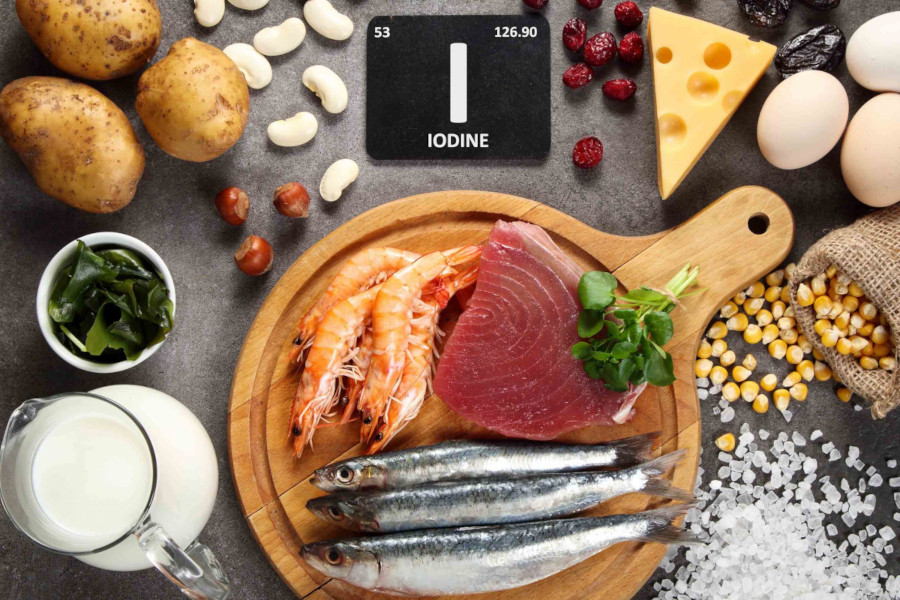
Iodised table salt remains the simplest and most reliable approach for most people. One teaspoon provides roughly 400-500 mcg of iodine – sufficient for daily needs. Returning to iodised salt for everyday cooking, while using specialty salts at the table if preferred, is low-risk and effective for most healthy adults.
Dairy products and eggs are good contributors for those who consume them. A glass of cow’s milk provides roughly 50-100 mcg depending on season and farming practice.
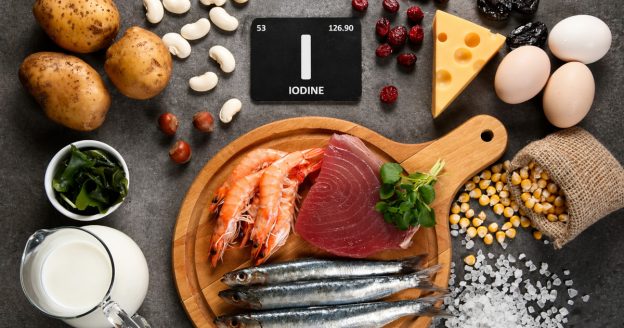
Fish and seafood are excellent sources. White fish such as cod and haddock, as well as shellfish, provide 50-200 mcg per serving depending on species. Smaller species – sardines, anchovies, herring – carry lower contamination risk than larger predatory fish and are among the most iodine-rich foods available.
Seaweed is the most concentrated food-based iodine source, but this is where the most care is needed. Iodine content varies enormously between species. Dulse (Palmaria palmata) is among the more suitable options for occasional use, with a moderate and relatively predictable iodine content of roughly 150-300 mcg per gram. Kelp and kombu can contain 1’500-4’000 mcg per gram and should not be used as routine iodine sources – regular consumption at any meaningful quantity risks exceeding the tolerable upper limit.
Iodine supplements in tablet or drop form are effective for those who cannot achieve adequate intake from diet. For most people who simply return to iodised salt or maintain adequate dairy and fish intake, supplementation is unnecessary. For pregnant women not achieving adequate dietary iodine, a prenatal supplement containing 150 mcg of iodine is recommended by health authorities in many countries – but should be discussed with a doctor or midwife, particularly for women with pre-existing thyroid conditions.
On excess: Both deficiency and excess iodine cause thyroid dysfunction. High acute intake suppresses thyroid hormone production through the Wolff-Chaikoff effect. People with Hashimoto’s thyroiditis or other autoimmune thyroid conditions are particularly sensitive to sudden increases in iodine intake and should approach supplementation with medical guidance. Japanese populations, who consume very high iodine through traditional seaweed-heavy diets, have developed physiological tolerance over generations – this adaptation does not apply to Central European populations with historically lower intakes. It is also worth knowing that iodine intake is not the only dietary factor that interacts with thyroid function: soy isoflavones can inhibit thyroid hormone synthesis through a separate mechanism, an effect that compounds with, rather than replaces, the importance of adequate iodine status. More on this here: → Soy: Miracle Food or Risk Factor?
Testing: Iodine status can be assessed through a urinary iodine concentration test, which reflects recent intake, or as part of a broader thyroid assessment including TSH, free T3, and free T4. If you have symptoms consistent with hypothyroidism – persistent fatigue, unexplained weight gain, cold intolerance, hair loss, brain fog – a thyroid panel is the right starting point, and iodine status should be considered as part of the picture.
Switzerland – Where Iodised Salt Was Invented
Switzerland’s geological iodine poverty is precisely the reason it led the world in iodised salt. Alpine terrain loses iodine through glaciation and leaching over millennia, leaving locally produced food very low in iodine. In certain regions before 1922, nearly half of all babies had palpable thyroid glands; up to 30 percent of young men were unfit for military service due to goitre. The introduction of iodised salt at 3.75 mg iodine per kilogram of salt transformed the population’s health within a generation.
The Swiss Fluoride and Iodine Commission continues to monitor population iodine status. The Commission has raised the iodine content of table salt progressively over the decades – 7.5 mg/kg in 1962, 15 mg/kg in 1980, 20 mg/kg in 1998, and 25 mg/kg since 2014. Each increase reflected survey data showing insufficient population iodine status. The fact that it has been necessary to raise the dose repeatedly over a century – even with iodised salt in place – illustrates how dependent Switzerland is on this single intervention.
For most people in Switzerland, the practical conclusion is simple: use iodised table salt for everyday cooking. It is the appropriate default for a population living in iodine-poor terrain, and it is available in every supermarket at negligible cost.
Iodine deficiency was solved in Switzerland a century ago, and the solution remains on the supermarket shelf. The challenge now is not access but awareness – the awareness that choosing specialty salts over iodised table salt, reducing dairy and fish intake, and not monitoring thyroid function can quietly accumulate into a deficiency that affects energy, weight, cognition, and in pregnancy the developing brain of the next generation. The remedy is neither expensive nor complicated. It begins with knowing that the problem exists.
Iodine is one of many nutrients where the gap between common assumptions and the actual evidence is larger than most people expect. For a broader look at vitamins and minerals – what the research supports, where the risks of over-supplementation lie, and why blood work should always come first – see: → Dietary Supplements – Benefits, Risks, and When They Actually Make Sense
Disclaimer: This article is for educational and informational purposes only and does not constitute medical advice. If you have symptoms consistent with thyroid dysfunction or iodine deficiency, please consult a qualified healthcare professional. Supplementation during pregnancy should always be discussed with your doctor or midwife.
Sources and Further Reading
- Feyrer, J., Politi, D., & Weil, D.N. (2017). The cognitive effects of micronutrient deficiency: evidence from salt iodization in the United States. Journal of the European Economic Association, 15(2), 355-387.
- Politi, D. (2010). The impact of iodine deficiency eradication on schooling: evidence from the introduction of iodized salt in Switzerland. Edinburgh School of Economics Discussion Paper Series 200.
- Daniel, K.S., & Mangano, K.M. (2025). Resurgence of iodine deficiency in the United States during pregnancy. Nutrition Reviews, 83(10), 1944-1956.
- Iodine inadequacy is prevalent and has continuously increased from 2001 to 2018 in the United States. The Journal of Nutrition (2025). doi:10.1016/j.tjnut.2025.09.017
- Iodine deficiency in the UK – should we take it with a pinch of salt? Proceedings of the Nutrition Society (January 2026). doi:10.1017/S0029665125000266
- Bath, S.C., et al. (2013). Effect of inadequate iodine status in UK pregnant women on cognitive outcomes in their children. The Lancet, 382(9889), 331-337.
- Zimmermann, M.B. (2009). Iodine deficiency. Endocrine Reviews, 30(4), 376-408.
- Swiss Academy of Medical Sciences / Fluoride and Iodine Commission. Iodine supply in Switzerland. samw.ch
- Swissinfo.ch (April 2026). The Swiss medical breakthrough that cured the ‘cretins of the Alps’. swissinfo.ch
- Klein, A. (23 April 2026). Iodised salt has become uncool but many of us need to eat more iodine. New Scientist. newscientist.com